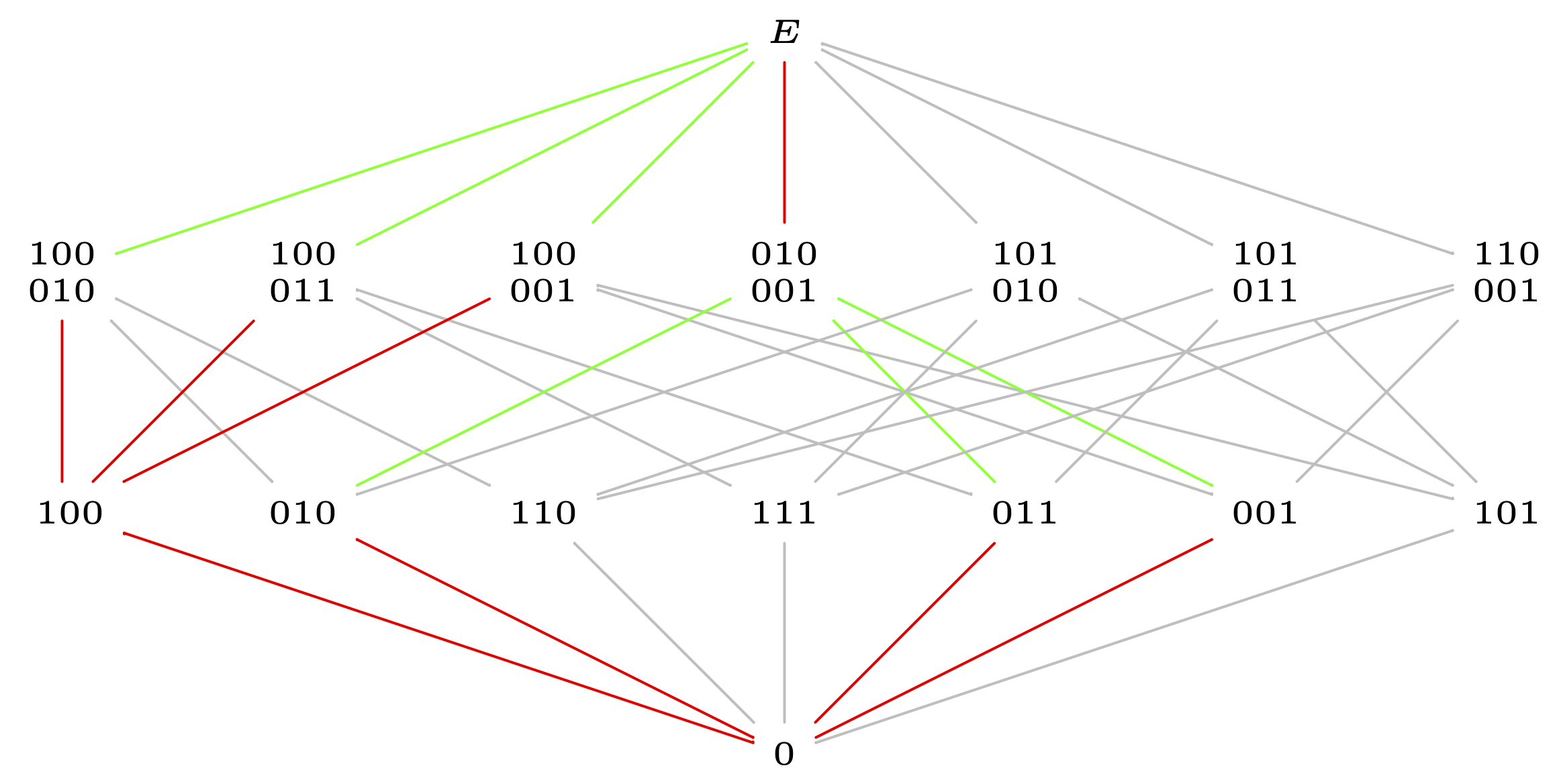
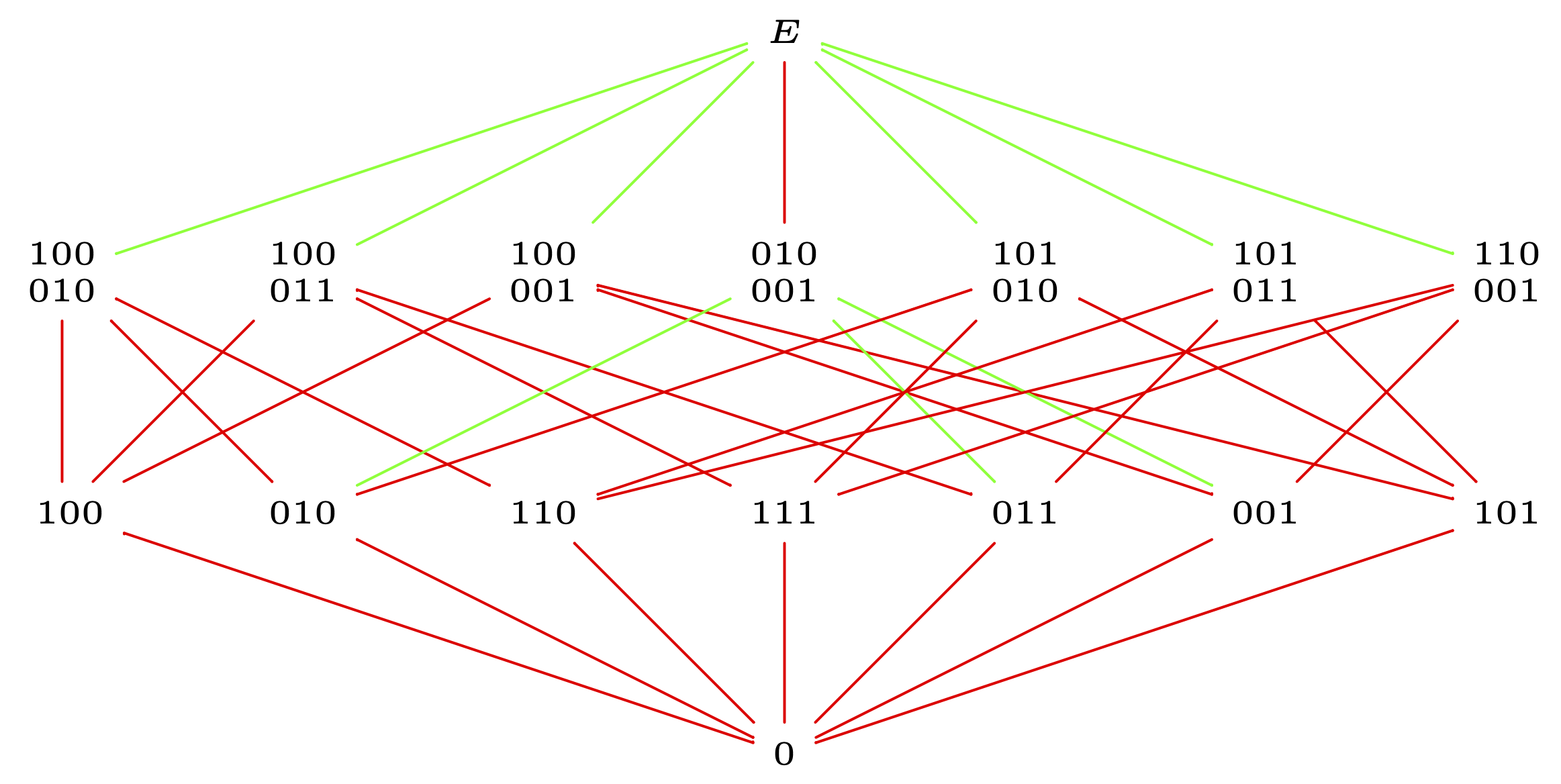
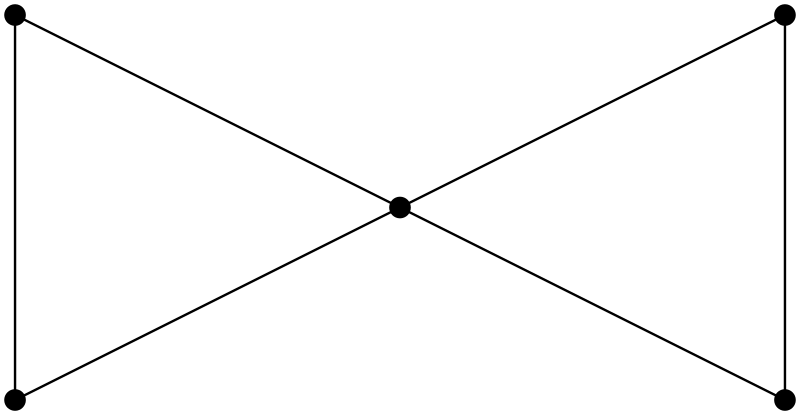
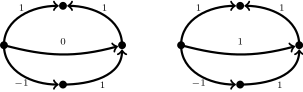
In this blog post, I’m going to discuss a part of a paper I wrote with Zach Walsh a few years back called “Matroid lifts and representability.” We’ll start by motivating the idea of a matroid lift.
Let $A \in \mathbb{F}^{r_1 \times n}$ and $B \in \mathbb{F}^{r_2 \times n}$ be matrices such that $A$ is a row-submatrix of $B$. Let $E$ denote the column set of $B$, which also naturally indexes the column set of $A$. Let $M_A$ and $M_B$ denote the matroids on ground set $E$ defined by linear independence in $A$ and $B$, respectively. Since $A$ is a row-submatrix of $B$, there is a special relationship between $M_A$ and $M_B$. In particular, every flat of $M_A$ is a flat of $M_B$. This motivates the following definition: given two matroids $M_1$ and $M_2$ on a common ground set $E$, one says that $M_2$ is a lift of $M_1$ if every flat of $M_1$ is a flat of $M_2$.
An Example
Recall that $U_{r,n}$ denotes the uniform matroid of rank $r$ on $n$ elements. One can check that $U_{2,3}$ is a lift of $U_{1,3}$. One can check this by noting that the flats of $U_{1,3}$ are the empty set, the full ground set, and each singleton set and that each of these are also flats of $U_{2,3}$. Alternatively, one can consider the following $\mathbb{Q}$-matrix
$\begin{pmatrix} 1 & 1 & 1 \\ 0 & 1 & 2 \end{pmatrix}$
and note that the matroid of the top row is $U_{1,3}$ and the matroid of the whole matrix is $U_{2,3}$. One interesting thing to note is that even though $U_{1,3}$ and $U_{2,3}$ are both $\mathbb{F}_2$-representable, there is no $2\times 3$ $\mathbb{F}_2$ matrix $B$ that represents $U_{2,3}$, whose top row represents $U_{1,3}$.
Notational Remark
For any matroid $Q$, I will use the notation $r_Q$ and ${\rm cl}_Q$ to denote the rank function and closure operator in $Q$.
Elementary lifts
If $M_2$ is a lift of $M_1$, then the rank of $M_2$ is greater than or equal to that of $M_1$. When $M_2$ is a lift of $M_1$ whose rank is exactly one greater than that of $M_1$, one says that $M_2$ is an elementary lift of $M_1$. I will now describe a classical theorem of Brylawski, the dual version of which was previously stated by Crapo, that gives an elegant combinatorial characterization of all elementary lifts of a matroid $M$.
Let $M$ be a matroid on ground set $E$. A linear class of $M$ is a collection $\mathcal{L}$ of circuits of $M$ such that if $C_1,C_2 \in \mathcal{L}$ satisfy
$|C_1 \cup C_2| – r_M(C_1 \cup C_2) = 2$
then if $C_3$ is a circuit of $M$ contained in $C_1 \cup C_2$, then $C_3 \in \mathcal{L}$. For each such linear class, one can define a function $r_\mathcal{L}: 2^{E} \rightarrow \mathbb{N}$ as follows
$r_\mathcal{L}(X) = \begin{cases}r_M(X) & \textnormal{if each circuit of } M|X \textnormal{ is in } \mathcal{L} \\ r_M(X) + 1 & {\rm otherwise}.\end{cases}$
For each linear class $\mathcal{L}$ of $M$, $r_\mathcal{L}$ is the rank function of a matroid $L$ such that $L$ is an elementary lift of $M$. What is even more interesting is that for every elementary lift $L$ of $M$, there exists a linear class $\mathcal{L}$ of circuits of $M$ such that the rank function of $L$ is $r_{\mathcal{L}}$.
Higher-rank lifts
I became aware of Zach’s existence when his paper “A new matroid lift construction and an application to group-labeled graphs” hit the arXiv. It gave a method for constructing non-elementary lifts of matroids in a way that generalized Brylawski’s construction. At the time, I was on the prowl for matroid theory tools that could be useful in rigidity theory, and matroid lifts had recently played a key role in a groundbreaking paper of Clinch, Jackson, and Tanigawa called “Abstract 3-Rigidity and Bivariate C12-Splines II: Combinatorial Characterization.” So I was very intrigued by Zach’s construction, which is given in the following theorem.
Theorem (Walsh): Let $M$ be a matroid on ground set $E$ with circuit set $\mathcal{C}$. Let $N$ be a matroid on ground set $\mathcal{C}$ such that if $|C_1 \cup C_2| – r_M(C_1 \cup C_2) = 2$, then each $C \in \mathcal{C}$ such that $C \subset C_1 \cup C_2$ satisfies $C \in {\rm cl}_N(\{C_1 \cup C_2\})$. Then the function $\rho_N: 2^E \rightarrow \mathbb{N}$ defined as follows is the rank function of a lift of $M$ of rank $r_M(E) + r_N(\mathcal{C})$
$\rho_N(X) = r_M(X) + r_N(\{C : C \textnormal{ is a circuit of } M|X\}).$
Zach’s construction generalizes Brylawski’s construction in the sense that when $r_N(\mathcal{C}) = 1$, the rank-zero flat of $N$ is a linear class $\mathcal{L}$ of circuits of $M$, and that $r_\mathcal{L} = \rho_N$. Zach had hoped that this construction would completely generalize Brylawski’s result in that every lift of a matroid $M$ would have rank function of the form $\rho_N$ for some matroid $N$ on the circuit set of $M$. As we will see, this is not the case. However, it does hold for matroid lifts that arise from taking the matroid of a matrix, and a row-submatrix. This gives us a way to test that a given lift is “representable” as a lift, and can even be turned into a test for matroid representability.
Theorem (B-Walsh): Let $A \in \mathbb{F}^{r_1 \times n}$ and $B \in \mathbb{F}^{r_2 \times n}$ such that $A$ is a row-submatrix of $B$. Let $M_A,M_B$ respectively denote the column matroids of $A$ and $B$ and let $\mathcal{C}$ denote the set of circuits of $A$. Then there exists a matroid $N$ on ground set $\mathcal{C}$ such that $\rho_N$ is the rank function of $M_B$.
Here is a sketch of the proof. Since $A$ is a row-submatrix of $B$ we may without loss of generality assume that $B$ has the following form for some matrix $C$
$B = \binom{A}{C}$.
For each circuit $C$ of $M_A$ let $x_C$ be a fixed element of $\mathbb{F}^n$ such that $Ax = 0$. Then $Bx_C$ can be written in the following form for some $x_C’ \in \mathbb{F}^{r_2-r_1}$
$Bx_C = \binom{0}{x_C’}$.
This enables us to define a matroid $N$ on the circuit set $\mathcal{C}$ of $A$ by asserting that $\{C_1,\dots,C_k\}$ is independent in $N$ if and only if the set of vectors $\{x_{C_1}’,\dots,x_{C_k}’\}$ is linearly independent in $\mathbb{F}^{r_2-r_1}$. Then, the rank function of $M_B$ is $\rho_N$.
Non-representable higher rank lifts
The proof of the above theorem heavily depends on access to a linear representation of the higher rank matroid, that has a row-submatrix representing the lower rank matroid. This dependence on a representation cannot be avoided, at least not in full generality. In particular, we can obtain a counterexample from the Vámos matroid.
Given any matroid $M$ on ground set $E$ and an independent subset $I \subset E$, $M\setminus I$ is always a lift of $M / I$ and the difference in ranks is $|I|$ and all lifts can be obtained in this way. Let $V_8$ be the matroid with ground set $\{1,2,\dots,8\}$ of rank $4$, such that every subset of size four or smaller is independent, with the exceptions of the following four-element subsets
$1234,3456,5678,1278,3478.$
This is known as the Vámos matroid, which is known to not be representable over any field. Then $V_8 \setminus \{7,8\}$ is a lift of $V_8 / \{7,8\}$, and as Zach and I show in our paper, there is no matroid $N$ of rank $2$ on the circuit set of $V_8 / \{7,8\}$ such that the rank function of $V_8 \setminus \{7,8\}$ is $\rho_N$. We generalize this construction to construct a two-parameter infinite antichain (in the minor partial order) of sparse paving matroids that are not representable over any field, that satisfy Ingleton’s inequality.
Concluding remarks
As with many papers I’ve written, the bulk of the time I spent “writing” this paper was spent chasing something I wound up being unable to prove. In particular, I was hoping to generalize the theorem about representable lifts of matroids being obtainable via Zach’s construction to the family of algebraic matroids. Alas, not only was I unable to prove that, I’m not so sure if it’s true anymore. But I really don’t have any reason to make a conjecture either way.